
Print-on-Demand vs Mass Production: What’s the Difference?
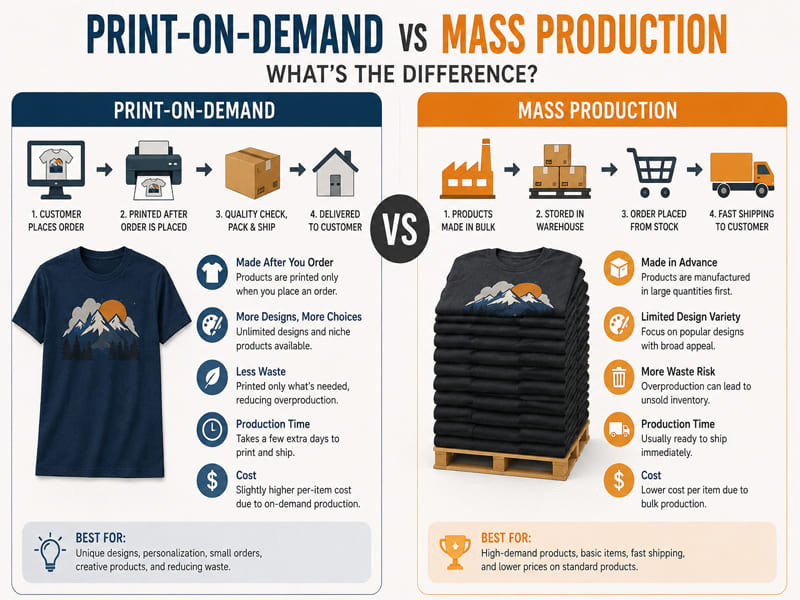
At Goseethem, When shopping online for graphic T-shirts, Posters, wall art, or personalized gifts, customers often see products described as print-on-demand or made-to-order. At first, these terms may sound similar to regular manufacturing, but they are actually very different from mass production. Understanding the difference can help you know what to expect when placing an order, from production time and print quality to shipping, returns, and product availability.
Print-on-demand is built around flexibility, creativity, and lower waste. Mass production is built around volume, speed, and large inventory. Both models have advantages, but they serve different purposes.
What Is Print-on-Demand?
Print-on-demand, often called POD, is a production model where an item is created only after a customer places an order. Instead of printing thousands of t-shirts or posters in advance, the design is applied to a blank product when someone buys it.
For example, if you order a graphic tee or poster from an online store, the product may not already be sitting in a warehouse fully printed. The design is printed specifically for your order, then packed and shipped.
This model is commonly used for:
- Graphic t-shirts
- Hoodies and sweatshirts
- Posters and wall art
- Custom gifts
- Fan-inspired apparel
- Niche designs and limited-style collections
Because products are made after purchase, customers should always check pages such as Shipping Information, Track Your Order, Return And Refund Policy, and FAQs to understand the full order process.
What Is Mass Production?
- Mass production is the traditional manufacturing method where a large quantity of the same product is made in advance. A company may print or manufacture hundreds, thousands, or even millions of identical items before customers buy them.
- This model is common for large retail brands, department stores, and fast-fashion companies. Products are usually stored in warehouses and shipped quickly once an order is placed.
- Mass production is best for products with predictable demand, such as plain white t-shirts, basic jeans, standard mugs, or widely popular seasonal items.
Main Difference Between Print-on-Demand and Mass Production
- The biggest difference is simple:
- Print-on-demand creates products after the order. Mass production creates products before the order.
- That one difference affects almost everything: cost, delivery time, waste, inventory, design variety, and customer expectations.
1. Inventory and Stock
- With mass production, brands must produce inventory in advance. This means they need to predict which designs, sizes, and colors will sell. If they guess wrong, unsold stock can sit in warehouses or become waste.
- Print-on-demand avoids this issue. A product is only printed when someone orders it. This allows stores to offer more creative designs without holding large amounts of inventory.
- For customers, this means POD stores can carry more unique designs, niche artwork, trending graphics, or limited-style products that may not exist in traditional retail.
2. Design Variety
- Mass production usually focuses on safe, broad designs because large quantities are expensive to produce. Brands often avoid risky or niche ideas because unsold inventory can become a financial loss.
- Print-on-demand allows more design freedom. A store can offer designs for specific interests, hobbies, fan communities, humor styles, music themes, sports culture, movie-inspired decor, or personal aesthetics.
- This is why many POD stores offer products that feel more personal and expressive than standard retail items.
3. Production Time
- Mass-produced products are usually ready to ship immediately because they are already made. That can make delivery faster.
- Print-on-demand products need extra production time because each item is made after checkout. A t-shirt must be printed, a poster must be produced, and the order must pass quality checks before shipping.
- That is why customers should read Shipping Information carefully before ordering. If the store provides tracking, customers can also use Track Your Order to follow the package after shipment.
4. Waste and Sustainability
- Mass production can create waste when too many products are made and not sold. Unsold inventory may be discounted heavily, destroyed, or stored for long periods.
- Print-on-demand helps reduce overproduction because items are only created when they are actually needed. This does not make every POD product automatically perfect for the environment, but it can reduce unnecessary inventory waste.
- For shoppers who care about mindful purchasing, POD offers a more demand-based approach.
5. Cost Structure
- Mass production can lower the cost per item because products are made in bulk. This is why large retailers may sell basic products at lower prices.
- Print-on-demand usually has a higher per-item production cost because each item is made individually or in smaller batches. However, the customer often gets access to more unique designs and niche products that would not be practical for mass production.
- In other words, mass production is efficient for basic products. Print-on-demand is powerful for variety, creativity, and personalization.
6. Quality Control
- In mass production, quality control happens across large batches. If there is a defect, it may affect many items at once.
- In print-on-demand, each product is produced individually. The quality depends on the blank product, print method, artwork file, ink quality, and fulfillment process.
- A good POD store should provide clear product descriptions, size information, image previews, and support pages such as Contact Us, FAQs, and Shopping Policies so customers can make informed decisions.
7. Returns and Refunds
- Returns can work differently between mass-produced products and print-on-demand products.
- With mass production, returned products can often be restocked and resold if they are unused. With print-on-demand, the item may have been made specifically for that order, design, size, or color. Because of this, some POD stores may have different return conditions.
- Before buying, customers should always review the Return And Refund Policy, Billing and Term conditions, and Terms of Service. These pages explain what happens if an item arrives damaged, if the wrong product is sent, or if a customer changes their mind.
Why Do Online Stores Use Print-on-Demand?
- Many modern ecommerce stores use print-on-demand because it allows them to offer fresh, creative, and niche products without producing large inventory in advance.
- For example, a store can release a new poster design, a funny graphic tee, or a fan-inspired product without needing to print hundreds of pieces first. If customers like the design, it gets produced. If not, the store avoids unnecessary waste.
- This makes POD useful for fast-changing trends, seasonal ideas, community-based designs, and unique personal styles.
Why Do Big Retailers Use Mass Production?
Large retailers often choose mass production because it is efficient for high-demand products. If a company knows it can sell thousands of identical items, producing in bulk makes sense.
Mass production works well for:
- Basic apparel
- Standard household goods
- Popular seasonal products
- Everyday essentials
- Large retail collections
The goal is consistency, speed, and lower unit cost.
Which Model Is Better?
Neither model is automatically better. It depends on what the customer wants.
Choose print-on-demand if you want:
- More unique designs
- Niche graphics
- Creative posters or apparel
- Made-to-order products
- Less overproduction
- Items with personal or fan-focused meaning
Choose mass production if you want:
- Very fast shipping
- Lower prices on basic products
- Standardized items
- Products already available in large quantities
For graphic tees, posters, and wall art, print-on-demand is especially useful because design variety matters. Customers are often looking for something that feels personal, expressive, or different from what they see in regular stores.
Final Thoughts
The difference between print-on-demand vs mass production comes down to how and when a product is made. Mass production creates large quantities before customers buy. Print-on-demand creates products after an order is placed, making it a flexible choice for graphic t-shirts, posters, wall art, and creative online gifts.
Before placing an order from any online store, take a moment to review the store’s About Us, Contact Us, FAQs, Shipping Information, Terms of Service, Privacy Policy, Return And Refund Policy, and Billing and Term conditions pages. These details help you shop with confidence and understand exactly what to expect from a made-to-order purchase
